
I Ching
Cast the ancient coins - 64 hexagrams of wisdom. Embeddable domain-locked widget, mobile-responsive.
Add this widget to your site
Free forever. Copy the snippet and paste it into any page — no coding required.
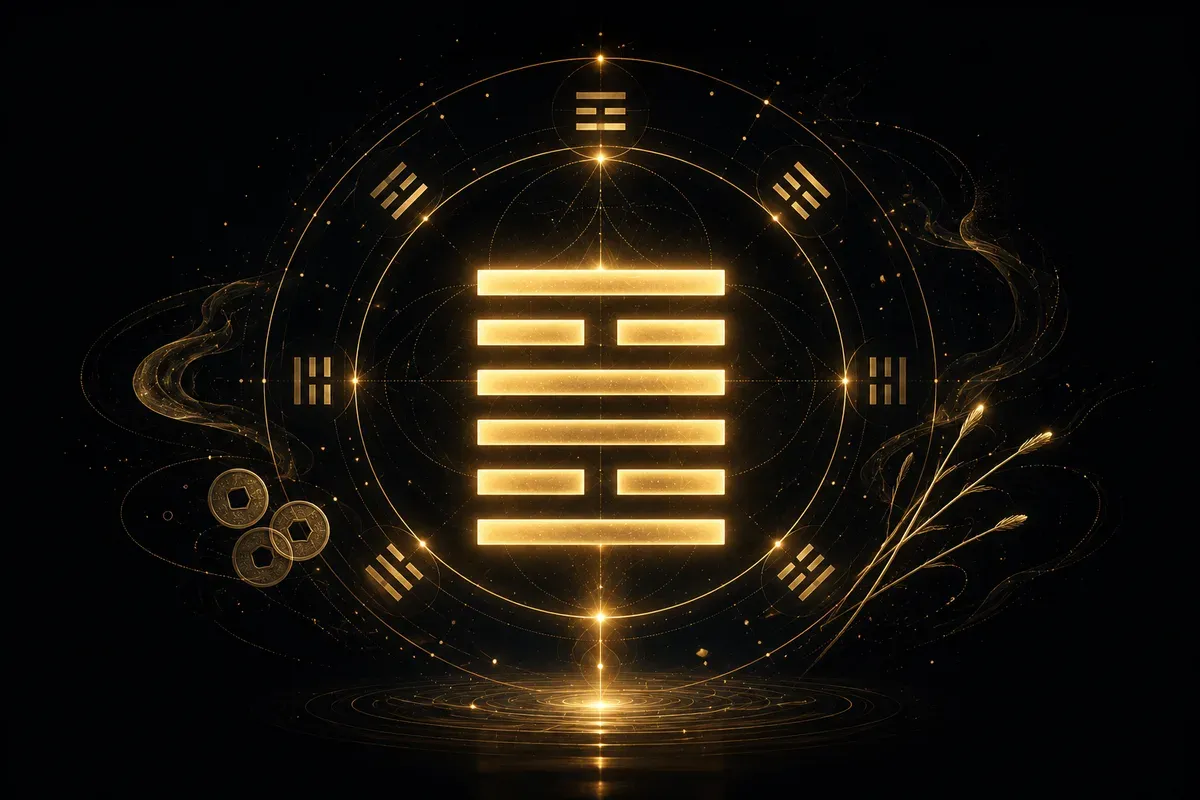
The I Ching is a 3,000-year-old Chinese divination system built on one observation: everything changes, and the moment you consult it, you're already inside a change. You get a hexagram - a six-line figure drawn from two trigrams - and the text that belongs to it. Not fortune-telling. More like: here is the pattern the moment is in; here is what that pattern suggests about movement, restraint, or timing.
How it works
Focus on your question, then cast your hexagram - either by clicking to simulate the traditional coin method (three coins, six tosses) or by the simplified digital draw. You'll receive your hexagram, its name, and an interpretation that addresses your situation from the hexagram's perspective. Changing lines, if present, reveal a second hexagram showing where things are moving.
Understanding your result
There are 64 hexagrams in the I Ching, and each one describes a state of affairs - not a personality type, but a moment. Hexagram 1 (The Creative) is about pure initiative, force, the right time to act. Hexagram 29 (The Abysmal) is about danger that must be moved through, not around. Changing lines modify the base hexagram and point toward its transformation. The interpretation is directional: it suggests a way to be in the situation, not a guaranteed outcome.
Frequently asked questions
What kind of questions work best?
Concrete situations work better than abstract ones. 'Should I respond to this offer?' works better than 'What is my life's direction?' The I Ching is better at describing the nature of a moment than at answering philosophical open questions.
What are changing lines?
When a coin toss produces all heads or all tails (a '6' or '9'), that line is 'changing' - it's in motion and will become its opposite. The resulting second hexagram shows where the situation is heading.
Is this the Wilhelm-Baynes translation?
The interpretations draw from classical I Ching texts and are written for clarity and practical use. They're informed by traditional sources but written fresh for this context.
Is this for entertainment or serious use?
Both. The I Ching has been used as a philosophical and strategic tool by serious practitioners for millennia, and as a reflective prompt by anyone curious. What you bring to it determines what you get.